
Updated for 2027
Recently Living Green Technology received several solar panels for recycling. These panels while used still had life in them and while we didn’t know the full story on why they were being recycled. It did getting thinking about one of our past blog post that covered solar energy.
We even asked one our in house employee’s who has solar what are some of the ins and outs of having solar power as well share any data about real life power generation, what happens with surplus power, and how the power utility determines how many panels you are allowed.
Rooftop solar arrays systems are becoming more popular these days. You can spot panels on homes from Seattle and Tacoma to Wenatchee and Yakima. But solar advice written even a year ago is now out of date.
The biggest change that folks need to know is: the 30% federal tax credit for homeowners ended on December 31, 2025. Net metering rules are also shifting, and while the eastern slops of the Cascades do have more sunny days in comparison to the west side, the math looks very different on either side of the mountains.
This guide covers all of Washington, with a focus on the west side and on communities east of the Cascades, such as those in Chelan, Douglas, Kittitas and Yakima counties. We cover and explain what still makes solar worth it in 2027, what it costs, and what to check before you sign a contract. And when its time for to properly dispose of the panels why Living Green Technology is the choice when it comes to recycling those panels.
Key takeaways
Summary: Solar still pays off for many Washington homeowners in 2027, but the math depends on where you live. West of the Cascades, rising utility rates and 1:1 net metering make the strongest case. Central Washington gets more sun, but in Chelan and Douglas counties some of the cheapest hydropower in the country makes payback much slower. With the federal tax credit gone, net metering, your utility’s rates and the right roof now decide whether panels are worth it.
- The 30% federal tax credit ended December 31, 2025. Systems you own that are installed in 2026 or later get no federal credit.
- Solar works on both sides of the Cascades. A Seattle system makes about 1,000 kWh a year per kilowatt, with roughly five times more power in July than in December. Panels around Yakima produce about 15% more over a year.
- Net metering is the most valuable incentive. It banks summer surplus for winter. PSE, Seattle City Light, Snohomish County PUD and Chelan and Douglas PUDs still credit exports 1:1. Pacific Power in the Yakima area and Kittitas County PUD have passed the state cap and are changing, or have changed, the rules.
- Cheap hydropower changes the math in central Washington. Chelan and Douglas PUD rates run roughly 2–4 cents per kWh, versus a state average of about 13.5 cents, so panels there pay back slowly.
- Washington’s main incentive is a sales tax break. The state waives sales tax on solar through 2029, worth about $1,150–$1,800 on a typical system, and panels don’t raise your property taxes.
- Expect about $33,000 for a typical Washington system before incentives, with payback of roughly 8–14 years and rising utility rates working in your favor.
- Your roof should be less than 15 years old. Most installers won’t mount panels on an older roof. Shade from trees and the direction your roof faces also decide whether your home is a good fit.
- Already have solar? Inverters usually need replacing at 10–15 years, adding panels can change your net metering plan, and old panels should be reused or recycled, not thrown away. Living Green Technology accepts old solar equipment at its Auburn location.
In this guide
- What changed: the federal tax credit is gone
- Yes, solar works in Washington, better than you might think
- Best month vs. worst month: what to expect
- Real-world numbers: a Tacoma system
- What solar costs, and how long it takes to pay off
- Incentives still available in Washington
- Net metering: your most valuable incentive, for now
- Is your roof a good fit?
- Do you need a battery?
- Choosing an installer
- Already have solar?
- Recycling old solar panels
- The bottom line
- FAQ
What changed: the federal tax credit is gone
If you buy a system with cash or a loan in 2027, there is no federal tax credit. The One Big Beautiful Bill Act, signed July 4, 2025, ended the 30% Residential Clean Energy Credit (Section 25D) for systems installed after December 31, 2025 (SEIA). It had been scheduled to run through 2032.
Timing rules are strict. A deposit paid or panels delivered in 2025 doesn’t count if the system wasn’t finished until 2026 (Tax47). If you did finish in 2025 and couldn’t use the whole credit, the unused amount carries forward to future tax returns.
One federal benefit remains, indirectly. Companies that own systems through leases and power purchase agreements (PPAs) can still claim a 30% commercial credit (Section 48E) for projects that begin construction by July 4, 2026 and are placed in service before 2028 (Beancount). Some of that savings may be passed on to you. The trade-off: you don’t own the system, and leased panels usually add little or nothing to resale value.
Yes, solar works in Washington, better than you might think
Cloudy skies cut output, but they don’t stop it. Panels still make power from diffuse light on overcast days. A typical Seattle system produces about 1,000 kWh a year for each kilowatt installed (8MSolar). That’s roughly a third less than Miami, not a fraction of it.
Our cool weather helps, too. Panels lose efficiency in heat, so long, mild summer days are close to ideal.
East of the Cascades, there’s more sun. By Profile Solar’s estimates, a panel in Yakima produces about 15% more power over a year than the same panel in Seattle, with the biggest gains in fall and winter (Profile Solar: Yakima, Profile Solar: Seattle).
| Season | Seattle (kWh per day, per kW) | Yakima (kWh per day, per kW) |
|---|---|---|
| Summer | 6.91 | 7.69 |
| Spring | 5.21 | 6.08 |
| Autumn | 2.54 | 3.19 |
| Winter | 1.33 | 1.56 |
The catch is the seasons. In Seattle, a panel makes about five times as much power on an average summer day as on a winter day (Profile Solar). Most systems here run a surplus from late spring to early fall and fall short in winter. That’s why net metering, covered below, matters so much in our region.
Best month vs. worst month: what to expect
If you have panels in Western Washington, your best month will make roughly five times as much power as your worst. For a 10 kW system near Seattle, that’s about 1,475 kWh in July and about 300 kWh in December (TheGreenWatt, NREL PVWatts data).
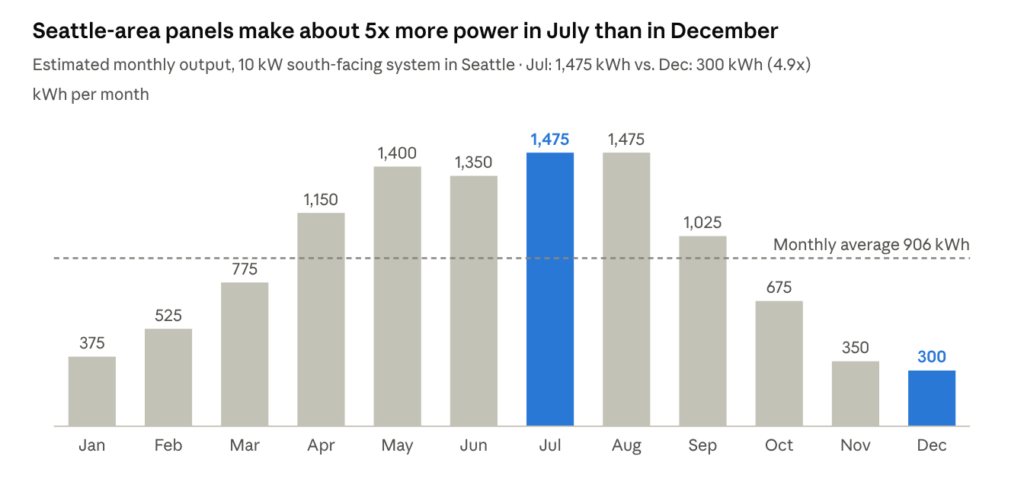
If your system is sized to cover your yearly use, months above the dashed average line are roughly when you bank net metering credits, and months below it are when you draw them down. Production climbs fast in spring, peaks in July and August, then drops sharply after September. In Western Washington, November through February together produce less than July and August alone.
Two practical tips for owners. First, don’t judge your system by a December bill; judge it by the full year, ending at your utility’s true-up date. Second, compare your actual monthly output with your installer’s estimate. A month that falls well short of its typical level can point to new shade, a dirty array or an equipment problem.
Real-world numbers: a Tacoma system
To see how the estimates hold up, here’s a full year of readings from a Tacoma homeowner, one of Living Green Technology’s own employees. The system has 15 panels at 400 W each (6 kW), mounted on a west-facing roof at a 15° tilt in the 98465 ZIP code. The numbers come from the homeowner’s Enphase monitoring dashboard.
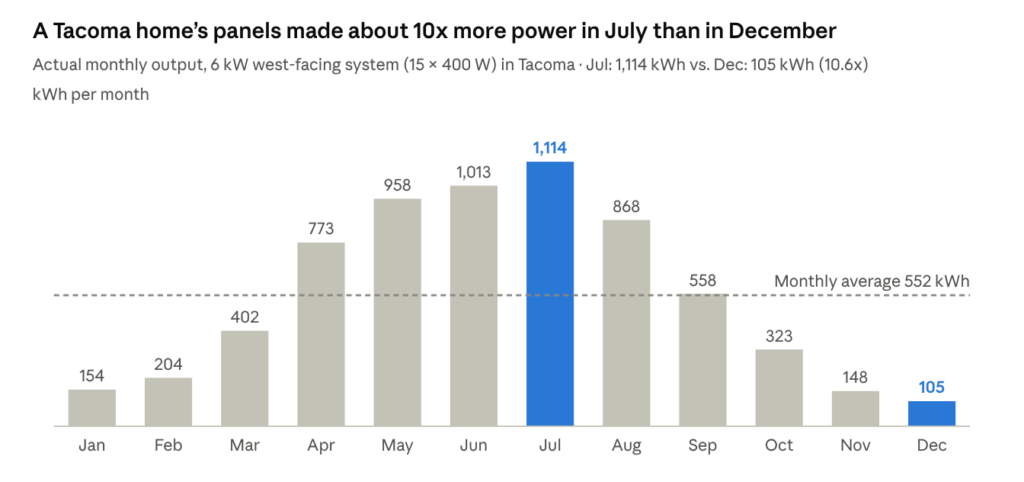
Over the year, the system produced about 6,620 kWh, or roughly 1,100 kWh per kilowatt, a bit above the Seattle estimate of about 1,000. July’s 1,114 kWh was about 10 times December’s 105 kWh, a wider swing than the estimate for a south-facing system.
Two things explain the deep winter dip. The roof faces west rather than south, so the panels catch mostly afternoon sun and get little from the low winter sun. A tree also shades the panels in the late afternoon. The installer told the homeowner that without those two factors, output would be at least 30% higher.
What solar costs, and how long it takes to pay off
A typical Washington system now costs about $33,000 before incentives. As of October 2026, Washington installs average $2.49 per watt, and the typical system is 13.41 kW, with quotes ranging from about $28,400 to $38,500 (EnergySage). Systems here run larger than in sunnier states because each panel produces less.
Without the federal credit, payback takes longer. Nationally, typical payback for an owned system has stretched from 6–10 years to 8–14 years (SurgePV). Your own number depends on your roof, your usage and your utility’s rates.
Your utility’s rate matters as much as your sunshine. Washington’s average residential rate is about 13.5 cents per kWh, and PSE raised rates 9.3% in 2026 (Grant PUD). Central Washington is a different story. Chelan PUD’s average residential rate was 3.82 cents per kWh in early 2026 (Chelan PUD), and the utility itself says its ultra-low rates mean a financial return isn’t a reason to go solar there (Chelan PUD). Douglas PUD’s energy charge held at 2.33 cents per kWh from 2020 through 2025 (KPQ). In those counties, solar makes sense mainly for clean energy, backup power or independence rather than savings.
Rising rates work in solar’s favor. PSE has asked regulators for a three-year rate plan that would add about $28 a month to a typical 800 kWh bill in early 2027, then about $7 in 2028 and $16 in 2029 (PSE). Every increase makes the power your panels produce worth more. EnergySage estimates a cash-purchased Washington system saves about $36,490 over 25 years.
Solar can also raise your home’s value. In a 2019 study, Zillow found homes with solar sold for 4.1% more than comparable homes (The Day), and newer studies report higher premiums. That boost applies to panels you own; leased systems generally don’t add resale value (EnergySage).
Incentives still available in Washington
Without the federal credit, Washington’s state programs carry more weight. Here’s what’s available as of October 2026.
| Incentive | What it’s worth | Good to know |
|---|---|---|
| Sales and use tax exemption | 6.5%–10.1% off equipment and installation, about $1,150–$1,800 on a typical system (PNW Residences) | Systems up to 100 kW; runs through December 31, 2029 |
| Property tax exclusion | Panels don’t raise your assessed value | Automatic under RCW 84.36.635 |
Washington has no state income tax, so it can’t offer a solar tax credit, and it has no state battery rebate (EnergySage). Chelan PUD’s long-running SNAP program, which paid local solar owners from customer donations, is no longer accepting new producers (Chelan PUD). Some other utilities and PUDs run their own rebates or low-interest loans, so search your utility’s name plus “solar incentive” before you get quotes.
Net metering: your most valuable incentive, for now
Net metering lets you bank summer surplus to cover winter shortfall. When your panels make more than you use, the extra flows to the grid and your utility credits you at the full retail rate. Credits roll over month to month.
In Washington, the credit bank resets each March 31, and unused credits are lost (EnergySage). That date works well here, since winter usually burns through your summer credits by then. Grays Harbor PUD is an exception: it credits exports at 50% of retail.
The rules are changing, so check where your utility stands:
- Washington utilities must offer net metering until June 30, 2029, or until net-metered systems reach 4% of the utility’s 1996 peak demand, whichever comes first. After that, a utility may switch to a less generous plan (WA Legislature). Several have hit the cap, but only a few have changed course (WA Commerce).
- Puget Sound Energy, which serves much of Western Washington and parts of Kittitas County, has committed to full retail net metering for new customers until a replacement plan is approved (Fire Mountain Solar, WattBuy). Seattle City Light and Snohomish County PUD also still offer 1:1 credit (PNW Residences).
- Chelan and Douglas County PUDs are far below the state cap, at about 4% and 3% of it, and still offer standard net metering (WSU Energy Program).
- Kittitas County PUD is well past the cap and has adopted its own rules, and the City of Ellensburg has also passed it. If you’re in either territory, ask the utility exactly how exports are credited before you sign (WSU Energy Program).
- Pacific Power, which serves the Yakima area, has passed the cap and asked regulators to move new customers to “net billing,” which pays less for exports. The decision is pending, with an effective date no earlier than February 1, 2027 (WA UTC). PacifiCorp is also selling its Washington business to Portland General Electric, a deal expected to take up to a year (Tri-Cities Area Journal of Business).
- Tacoma Power (Tacoma Public Utilities) is about halfway to the state cap and still credits exports 1:1 (WSU Energy Program). It also caps system size based on a share of your annual electricity use; for the Tacoma homeowner above, the most it allowed was 15 panels. Tacoma Public Utilities explains the steps in its guide, What you need to know before installing solar panels on your roof.
Existing customers are usually grandfathered when rules change. Ask your installer which plan you’ll be on, and get it in writing. Where exports earn less, size your system to match your own use rather than to sell power back.
Is your roof a good fit?
Across Washington, roof age decides more solar projects than anything else, and on the west side, so do trees. Before you collect quotes, walk through these checks:
Roof age: under 15 years
Most installers won’t put panels on a roof that’s more than 15 years old. Panels last 25 years or more, and taking them down and putting them back up for a roof replacement adds real cost, so an older roof usually needs replacing first. Composition shingle and standing-seam metal are the easiest to work with; tile and cedar shake cost more to install on.
- Shade. Tall Douglas firs and cedars can shade a roof for hours, especially in winter when the sun sits low. Ask for a shade analysis, and remember that trees on a neighbor’s lot count too.
- Direction. South-facing roofs produce the most. East- and west-facing roofs still work; a west-facing array produces more in the late afternoon.
- Angle. Most installers mount panels flat against the roof. In Seattle, the ideal year-round tilt is about 39 degrees facing south (Profile Solar), but a typical roof pitch gets close enough.
- Moss and debris. Our damp climate grows moss fast. Treat the roof before installation, and ask about critter guards that keep needles and nesting birds out from under the panels. Rain does a good job of keeping the panels themselves clean.
- Dust. Central Washington’s dry climate lets dust build up on panels between rains (Profile Solar), so plan on an occasional gentle rinse.
- Snow and wind. In Leavenworth, Cle Elum, the Yakima foothills and other snowy areas, make sure the racking is rated for local snow loads. In the windy Kittitas Valley, ask about wind ratings too.
Do you need a battery?
Solar panels alone won’t keep your lights on in a power outage. Grid-tied systems shut off automatically when the grid goes down, to protect utility crews working on the lines. If winter windstorms regularly knock out your power, a home battery is what provides backup.
A battery pays off best if your utility credits exported power at less than retail, as Pacific Power has proposed for the Yakima area, since storing your own surplus is then worth more than selling it. Currently, Washington has no state battery incentive, though PSE has launched a virtual power plant program that pays battery owners to share stored power during peak demand (EnergySage).
With full retail net metering and few outages, many homeowners can skip the battery for now and add one later.
Choosing an installer
A good installer handles the permits, the utility interconnection and the incentive paperwork for you. Get at least three quotes, and ask each one:
- Are you a licensed electrical contractor in Washington?
- Will you install on my roof as it is, or does it need replacing first?
- What will my system produce in kWh per year, and how did you account for shade?
- Which net metering or net billing plan will I be on, and will you file the application?
- Does this quote include the Washington sales tax exemption? (Washington buyers give the installer an exemption certificate instead of paying the tax.)
- What warranties cover the panels, the inverter and your workmanship, and for how long?
- If it’s a lease or PPA, what happens when I sell the house?
- If you’re replacing or adding panels, will you remove and recycle the old ones, and will the change affect my net metering plan?
Be wary of any quote that still subtracts a 30% federal tax credit from the price of a system you’d own. That credit no longer applies to new installations.
Already have solar? Replacing, upgrading or adding panels
Many Washington systems went up in the 2010s and are now reaching middle age. The good news is that panels age slowly. Output typically drops about 0.5% a year, so a 20-year-old panel still produces about 90% of what it did when new (pv magazine). The inverter is usually the first part to go, typically between years 10 and 15 (A1 Solar Store). For most owners, a new inverter, not new panels, is the main mid-life repair.
If you want more power, perhaps for an EV or a heat pump, you have two paths:
- Expand the system you have. This works best when your inverter has spare capacity or you have microinverters. New panels won’t match the old ones exactly, and you may need a separate monitoring app (EnergySage).
- Add a second, separate system. Many installers prefer this, because wiring new panels into an older string-inverter setup can mean rewiring the whole array (EnergySage).
Either way, check net metering first. Expanding a system means a new permit and a new interconnection application, and a utility can move your whole system onto its current rules, not just the new panels (EnergySage). PSE’s net metering tariff covers both new and modified systems and requires owners to report any changes (PSE Schedule 150). Where 1:1 credit still applies, as with PSE and Seattle City Light today, that may cost you little. In Kittitas County PUD or Pacific Power territory, ask the utility in writing how an expansion would change your credits before you add a single panel.
Replacing panels that still work, just to get newer, more efficient ones, rarely pays for itself. The better moment to upgrade is when your roof needs replacing anyway: the panels have to come off regardless, so you can decide then whether to reinstall the old ones or put up new ones. Remember that the federal tax credit no longer covers new equipment.
Recycling old solar panels
Panels last 25 years or more, but they don’t last forever, and they shouldn’t go in the trash. About 80% of a panel’s weight is aluminum and glass, which are easy to recycle, and the silicon, plastics and other metals can be recovered too (WA Ecology). Here are your options in Washington today:
- Reuse first. A panel that still works isn’t waste. Most panels are guaranteed to produce 80% of their rated output after 25 years, so working panels removed during a re-roof or upgrade can be sold or donated (WA Ecology).
- Recycle the rest. Panels from a home generally fall under the state’s household waste exclusion, so you can take them to a recycler that accepts solar panels; the EPA keeps a list of facilities. A landfill can take them only with its approval, and recycling is the better choice. Leased panels count as business waste and follow stricter rules (WA Ecology).
- Know your panel type. Most home panels are silicon. Thin-film cadmium telluride panels are more likely to count as dangerous waste, so tell your recycler what you have (WA Ecology).
- Budget for it. Recycling typically costs $15–$45 per panel, compared with $1–$5 to landfill, though recycling costs are falling (Earth911). Removal labor is usually extra, so ask your installer to include removal and recycling in any re-roof or upgrade quote.
Recycle your old solar equipment with Living Green Technology
We accept used solar panels and other old solar equipment for recycling at our Auburn headquarters.
1720 Pike St NW, Suite 4
Auburn, WA 98001
Monday–Friday, 8:30 a.m.–4:30 p.m.
Please call before you come so we can confirm what you’re bringing.
The bottom line
Solar still pays off for many Washington homeowners in 2027, but it takes a closer look than it used to. It works best if you own your home long-term, have a roof under 15 years old that’s mostly unshaded and faces south, east or west, and get full retail net metering. On the west side, act while PSE, Seattle City Light and Snohomish County PUD still credit exports 1:1. Around Yakima and in Kittitas County, confirm how your utility will credit exports before you sign. In Chelan and Douglas counties, go in knowing that cheap hydropower makes savings slow.
Get several quotes, ask how your utility’s rules affect the savings, and make sure every number reflects 2027 rules.
Frequently asked questions
Is solar worth it in Washington in 2027?
For many homeowners, yes, especially west of the Cascades, where utilities like PSE, Seattle City Light and Snohomish County PUD still credit exported power 1:1 and rates keep rising. In Chelan and Douglas counties, very low hydropower rates make savings slow, so solar there is mostly about clean energy or backup power.
Is there still a federal solar tax credit?
Not for systems you own. The 30% Residential Clean Energy Credit ended for systems installed after December 31, 2025. Companies that lease systems or sell power through a PPA can still claim a commercial credit for qualifying projects and may pass some of that savings on.
How much power do solar panels make in Seattle in winter?
Much less than in summer. A 10 kW south-facing system near Seattle makes roughly 300 kWh in December and about 1,475 kWh in July. Net metering lets you bank the summer surplus to cover the winter gap.
Does PSE still offer net metering?
Yes. PSE has committed to full retail net metering for new customers until regulators approve a replacement plan. Unused credits reset each March 31, so ask your installer which plan you’ll be on and get it in writing.
How old can my roof be before installing solar?
Under 15 years. Most installers won’t mount panels on an older roof, because removing and reinstalling them for a roof replacement adds real cost.
Where can I recycle old solar panels near Seattle?
Living Green Technology accepts used solar panels and other old solar equipment at its Auburn headquarters, 1720 Pike St NW, Suite 4, Auburn, WA 98001, Monday through Friday from 8:30 a.m. to 4:30 p.m. Call 253-204-4438 before you come. The EPA also keeps a list of solar panel recyclers.
Going green doesn’t stop at the roof. Living Green Technology is a locally owned electronics recycler serving Seattle, the Eastside and South King County. We’ll pick up your unused electronics and recycle them responsibly, and we offer secure data destruction. Replacing old solar equipment? Bring it to our Auburn headquarters for recycling. Schedule a pickup today at 253-204-4438, or shop our refurbished electronics at discounted prices.
Sources
- SEIA: Clean energy provisions in the One Big Beautiful Bill
- Tax47: Solar tax credit ended in 2026
- Beancount: Section 25D final year and lease/PPA alternatives
- SurgePV: Solar tax credit 2026 guide
- 8MSolar: Is solar worth it in a cloudy climate?
- Profile Solar: Seasonal solar output by location
- EnergySage: Washington solar incentives 2026
- WA UTC: Renewable energy incentives
- PNW Residences: Solar stats 2026
- SurgePV: Washington solar incentives 2026
- WA Legislature: HB 1427 bill analysis (net metering)
- WA Department of Commerce: Net energy metering
- Fire Mountain Solar: UTC approves PSE net metering extension
- PSE: 2026 general rate case
- The Day: Zillow finds 4.1% solar home premium
- EnergySage: Solar and home values
- WA Department of Ecology: Solar panel stewardship program
- WA Department of Ecology: Managing solar panel waste
- Solar Power World: JinkoSolar takeback program approved in Washington
- TheGreenWatt: Peak sun hours in Washington (NREL PVWatts v8)
- Profile Solar: Yakima solar PV analysis
- WSU Energy Program: Net metering status by utility (January 2026)
- WattBuy: Kittitas electric utilities
- WA UTC: Docket UE-250695 (Pacific Power net billing)
- Tri-Cities Area Journal of Business: PacifiCorp selling its Washington business to PGE
- Grant PUD: 2026 rates package
- Chelan PUD: Q2 2026 quarterly financial report
- Chelan PUD: Renewable energy
- Chelan PUD: SNAP program
- KPQ: Douglas County PUD future rates
- pv magazine USA: How long do residential solar panels last?
- A1 Solar Store: Solar panel degradation
- EnergySage: Adding solar panels to an existing system
- PSE: Schedule 150, Net metering services
- Earth911: Recycling solar panels in 2026
- US EPA: Solar panel recycling
- Tacoma Public Utilities: What you need to know before installing solar panels on your roof
- Enphase Enlighten monitoring portal (source of the Tacoma homeowner’s data)
- Living Green Technology: Auburn location