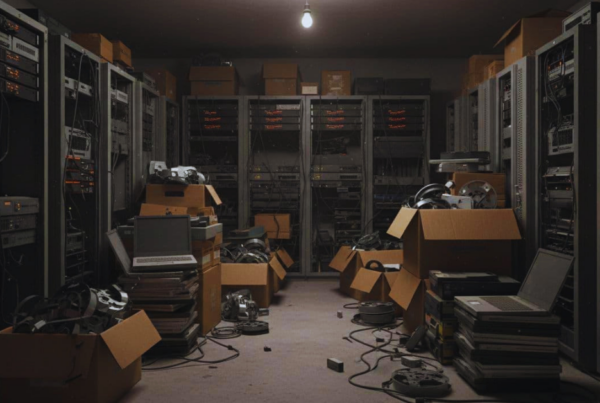


Retired gear can be more dangerous than active gear. That sounds backwards, but it’s true. Public utilities run grid operations, customer billing, and operational technology (OT) that keeps services steady. When devices leave service, they often still hold sensitive settings, credentials, logs, and customer records.
Today’s risk climate makes that leftover data a real target. Ransomware crews steal files to pressure payments. AI tools help attackers move faster. Supply chain exposure adds risk when equipment changes hands. On top of that, utilities face mixed threats, where a physical loss leads to a cyber incident.
If you manage public utility e-waste Seattle routes, plan municipal electronics recycling, or oversee critical infrastructure data disposal Washington, disposal has to sit inside your security program. This guide explains wipe vs destroy, what proof matters, and how to pick a partner you can defend in an audit.
What kinds of sensitive data live on utility equipment long after it is “retired”?
Most “retired” devices aren’t empty. They’re more like file cabinets that someone forgot to lock. Even if a project ended years ago, the device may still store configs, cached passwords, local admin accounts, saved remote sessions, and exported reports.
Utility environments make this harder because IT and OT overlap. A laptop might manage office work in the morning, then connect to a substation network in the afternoon. A workstation can hold documents and also run tools tied to SCADA support. As a result, secure disposal has to treat both IT and OT as in scope, not separate worlds.
Chain of custody is the glue that holds it together. If you can’t show who handled what, when, and where it was stored, you can’t prove the data stayed protected. That matters after an incident, a public records request, or an audit. It also matters when your legal team asks a simple question: “Can we show this drive was destroyed?”
Grid and OT devices can expose how the system runs
Control room workstations, HMI terminals, engineering laptops, and substation support PCs often keep the “how it works” details. That can include SCADA-related configs, network diagrams, VPN profiles, firewall exports, credentials stored in scripts, event logs, and firmware backups. Even old diagrams help attackers, because core architecture and naming schemes don’t change overnight.
An outage doesn’t always start with a zero-day exploit. Sometimes it starts with a simple map of your environment.
For broader context on why electronics should be handled with formal processes, see the EPA overview of electronic waste (e-waste).
Billing and customer systems carry personal and financial data
Billing servers, call center PCs, field service tablets, printers, and multi-function devices can store customer names, addresses, payment history, and account notes. Email archives and report exports often contain even more, especially when teams move files “temporarily” for a project.
The harm is easy to picture. A stolen billing export can fuel fraud. A leaked customer list can cause identity theft. Just as damaging, it can break trust with the people your utility serves. Public utilities also carry a higher duty of care because customers often can’t choose another provider.
Treat retired devices like unencrypted backups. If you wouldn’t post the contents online, don’t let the hardware leave without verified destruction.
Choosing the right data destruction method: DoD-style wipes, modern guidance, and when to destroy hardware
A secure disposal plan usually comes down to one decision: should you sanitize the media for reuse, or destroy it for certainty? Both can be correct, but only when the media type, condition, and risk level match the method.
Many organizations still reference DoD 5220.22-M style overwrite as a known approach for traditional hard disk drives (HDDs). At the same time, modern programs often align to NIST SP 800-88 concepts, which separate actions into “clear” (logical removal) and “purge” (more thorough sanitization) based on risk and media type. That split matters because SSDs and flash storage don’t behave like HDDs.
Before you approve a disposal plan, run this short checklist:
- Media type: HDD, SSD, NVMe, flash, embedded storage, or device memory?
- Device condition: working, damaged, water-exposed, or failed drive?
- Data sensitivity: OT configs, credentials, BCSI-like material, or customer data?
- Reuse allowed: can the device be redeployed, resold, or donated?
- Proof required: do you need per-asset logs and a Certificate of Destruction?
A vendor should be able to explain the method in plain language. If they hide behind buzzwords, that’s a red flag.
DoD-standard wipe options and what they are good for
For HDDs, multi-pass overwrite can still be useful when you want reuse and you can verify results. A proper wipe includes verification logs tied to asset IDs, drive serial numbers, and completion status. That paperwork matters just as much as the erase itself.
Wiping supports redeploy, resale, or parts recovery when policy allows it. It can also reduce costs because you keep value in the device.
However, wipes have limits. They aren’t reliable for damaged drives that won’t read and write correctly. They also fail when encryption keys are unknown, because you can’t validate what’s actually accessible. Many SSD and flash scenarios add another problem: wear leveling and hidden blocks can leave data where a simple overwrite won’t touch it.
General industry best practices can help frame your internal policy, including guidance like this e-waste disposal best practices overview.
Physical destruction for the most sensitive hardware
Physical destruction is the “no doubts” option. Common methods include shredding, crushing, and degaussing (for certain magnetic media). For SSDs and other flash storage, shredding or crushing is often preferred because it breaks the memory chips themselves.
DIY drilling feels satisfying, but it’s inconsistent. It can also be unsafe, especially with modern devices, batteries, and tight enclosures. More importantly, it doesn’t create defensible evidence unless you have a controlled process and documented results.
Choose destruction when the asset is end-of-life, the device holds high sensitivity OT material, or the hardware was involved in an incident. When your risk team wants absolute certainty, destruction is usually the cleanest answer.
Proof, compliance, and picking a secure partner in Washington
Utilities don’t just need good security, they need defensible security. That means proof you can hand to auditors, leadership, and regulators. For many electric utilities, the North American Electric Reliability Corporation (NERC) Critical Infrastructure Protection (CIP) standards shape how teams think about asset controls, documentation, and evidence.
While your exact obligations depend on scope and classification, evidence habits matter. NERC even publishes tools that show how evidence requests get structured, such as the NERC CIP Evidence Request Tool user guide. Disposal is part of that story because a retired asset can still expose sensitive information.
Living Green Technology provides NERC CIP-compliant data destruction services with Certificates of Destruction. Secure processing also depends on where and how the work happens. Living Green Technology operates a secure facility in Auburn, Washington, built for controlled handling of retired equipment, documented steps, and responsible downstream recycling.
Certificate of Destruction and chain-of-custody, what your auditors will want
A Certificate of Destruction should read like a clear timeline, not a vague receipt. At a minimum, it should include asset identifiers (tag and serial where possible), the destruction or wipe method, date and time, location, and authorized sign-off. When someone claims a breach started with “disposed” equipment, this certificate can protect the utility and shorten investigations.
Ask any vendor a few direct questions:
- Tracking: How do you track each asset from pickup to final outcome?
- Reporting: Do you provide per-serial logs and exception reports?
- Where work happens: Is wiping or destruction done on-site, or shipped elsewhere?
- Access control: Who can enter processing areas, and how is access logged?
- Downstream: Which recyclers or refineries receive material, and how are they vetted?
How Living Green Technology supports utilities from pickup to final processing in Auburn
A strong program feels predictable. First, the utility and vendor agree on an inventory approach, including tags, serial capture, and what gets wiped versus destroyed. Next, a scheduled pickup keeps devices out of hallways and unsecured cages. Locked transport and documented transfers protect chain of custody.
After arrival at the Auburn facility, the equipment follows the chosen path: verified wiping with logs, or physical destruction for higher-risk items. Then the utility receives documentation, including Certificates of Destruction, followed by responsible recycling of remaining materials.
Partner with Living Green Technology for secure disposal of your utility’s retired equipment.
Conclusion
Retired utility tech isn’t just surplus, it’s a security project with real consequences. Because utilities hold OT details and customer data, you need a clear decision rule for wipe vs destroy, and you need proof that stands up later. Align your process to NERC CIP expectations: controlled handling, documented chain of custody, and a Certificate of Destruction that ties back to each asset.
If you want disposal you can defend in an audit and trust during an incident, Partner with Living Green Technology for secure disposal of your utility’s retired equipment.